
Common Termites: How to Identify Them and What to Do Next
What It Means When You See Swarmers
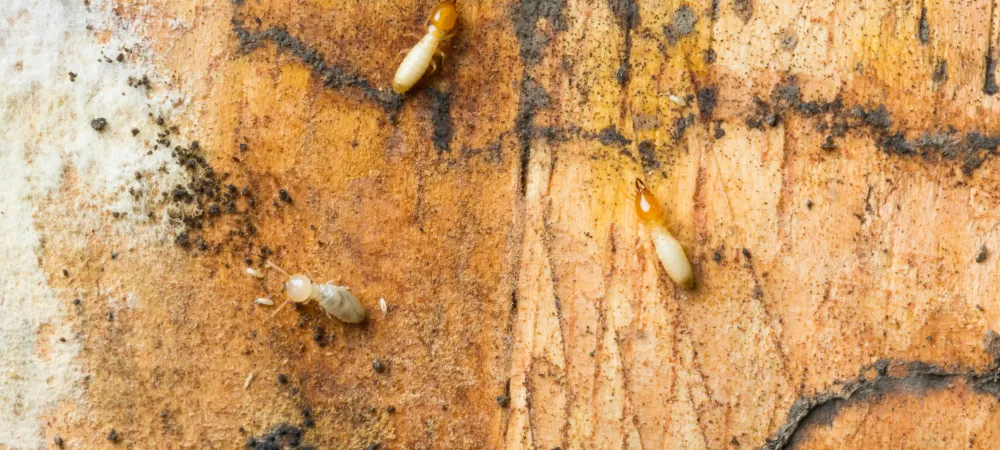
Termite swarmers — winged reproductive termites that emerge in spring to start new colonies — are the first sign most homeowners notice. If you're finding them inside your home near windows, light fixtures, or exterior doors in March, April, or May, the colony producing those swarmers has been active at your structure for a long time. Swarmers emerge from mature colonies, and Eastern subterranean termite colonies typically require 3 to 5 years to reach reproductive maturity. Seeing swarmers means the damage has already been accumulating.
The most important thing to do when you see swarmers is not to treat them — they die quickly and don't cause damage themselves — but to call a termite professional for an inspection. Swarmers are a symptom of an established colony, not the problem itself.
Flying Ants vs. Termite Swarmers: How to Tell the Difference
The most common identification mistake homeowners make is confusing termite swarmers with flying ants. Both emerge in spring, both are winged, and both can appear inside near light sources. The differences are consistent and reliable:
Body shape: Termite swarmers have a straight, thick waist — their body is roughly the same width throughout. Flying ants have a pinched waist (the characteristic hourglass shape of all ants).
Wings: Termite swarmers have four wings of equal length that extend well beyond the body. Flying ants have two larger wings in front and two smaller wings in back. Termites shed their wings shortly after swarming, leaving small piles of equal-length wings near entry points — this is a reliable indicator that a swarm occurred even if you didn't witness it.
Antennae: Termite antennae are straight and bead-like (called moniliform). Ant antennae are bent or elbowed.
If you're finding shed wings of equal length near a window sill or door frame, you have termite swarmers. That warrants a professional inspection.
Termite Species in the Frontline Pest Control Service Area
Eastern Subterranean Termite (Reticulitermes flavipes) is by far the most common species across Maryland, Virginia, Delaware, West Virginia, and Tennessee. Eastern subterranean termites live in underground colonies and build mud tubes — pencil-width tunnels of soil and saliva — to travel between soil and the wood they're consuming. They are cryptic feeders: they consume wood from the inside out, following the grain, and can cause significant structural damage before surface signs appear. Workers are pale, creamy-white, and roughly 1/8 inch long. Eastern subterranean termites swarm in spring, typically on warm days following rain.
Formosan Subterranean Termite (Coptotermes formosanus) is established in parts of Tennessee and is expanding its range northward through the Southeast. Formosan colonies are significantly larger than Eastern subterranean termite colonies — a mature Formosan colony can contain several million workers compared to the several hundred thousand typical of Reticulitermes — and cause damage at a faster rate. Formosan termites also build carton nests (a mixture of soil, wood, and fecal material) inside wall voids, which means colonies don't always need continuous soil contact. If you're in the Nashville metro and seeing termite activity, Formosan presence should be assessed.
Drywood Termites are less common in Frontline Pest Control's core service area but can be found in coastal markets in the mid-Atlantic. Unlike subterranean termites, drywood termites don't require soil contact — they infest dry, sound wood and create galleries with clean, smooth walls. The signature indicator of drywood termites is frass: small, six-sided pellets pushed out of the wood through small kick-out holes. Drywood termite infestations are typically smaller than subterranean colonies but can go undetected for years.
The Brick House Myth
A persistent misconception is that brick homes are protected from termites. Termites don't eat brick — but they eat the wood framing inside brick homes just as readily as any other construction type. Every brick veneer home has wood floor joists, sill plates, interior wall framing, and structural beams that are fully accessible to subterranean termites entering from soil contact at the foundation. In some cases, brick construction provides better soil-to-wood pathways than frame construction because the interior wood members rest closer to grade. Brick exterior appearance offers no termite protection whatsoever.
Signs of Termite Activity Beyond Swarmers
Most termite damage occurs in areas homeowners don't see regularly. The signs to look for:
Mud tubes: Pencil-width tunnels of soil running up foundation walls, across crawl space piers, along floor joists, or through expansion joints in concrete slabs. Mud tubes are the most reliable evidence of active Eastern subterranean termite activity.
Wood damage: Termites consume wood along the grain, leaving a honeycombed pattern inside structural members that looks intact on the surface. Tapping wood with a screwdriver handle and listening for a hollow sound — particularly in door frames, window sills, and floor joists — can identify damaged areas. A screwdriver tip that penetrates a floor joist with minimal pressure indicates significant structural damage.
Frass near wood: Small piles of six-sided pellets near wood members indicate drywood termite activity.
Bubbling or uneven paint: Paint that appears bubbled or blistered on wood surfaces, particularly window frames and door casings, can indicate moisture from termite tunneling below the surface — though this sign is not specific to termites alone.
What to Do If You Find Termite Signs
Do not apply store-bought termite products if you find signs of active termite activity. Liquid termiticide applied incorrectly at the foundation can repel termites away from the treated area into untreated wood, making the infestation harder to locate and treat thoroughly. Professional termite treatment involves a systematic approach — either a liquid treatment at the foundation perimeter or a monitoring-and-baiting system like Sentricon — that requires licensed application.
Call Frontline Pest Control for an inspection. We'll identify the species, locate the activity, and recommend the right treatment approach for your home and market.
FAQ
How long does it take for termites to cause serious damage? It depends on colony size and species. Eastern subterranean termite colonies consume wood slowly compared to Formosan colonies — a typical Eastern subterranean colony may cause $3,000 to $5,000 in damage over several years. A mature Formosan colony can cause comparable damage in a single season. The key variable is how long the infestation goes undetected, which is why annual inspections matter in high-pressure markets.
Does homeowner's insurance cover termite damage? Standard homeowner's insurance policies in the United States exclude termite damage as a preventable maintenance issue. Termite damage repair — which can range from replacing a few floor joists to full foundation framing — is paid out of pocket by the homeowner in virtually all cases. This is one of the strongest arguments for preventive treatment rather than reactive repair.
How often do I need a termite inspection? In Frontline Pest Control's service area, annual termite inspections are the appropriate standard. Markets in Tennessee, Virginia, and Southern Maryland carry particularly high termite pressure and warrant consistent monitoring. If your home is under a Sentricon service agreement, monitoring is built into the program — stations are checked on a scheduled basis throughout the year.
Found something that looks like it might be termite activity — or just want to know your home's risk level? Call Frontline Pest Control at 877-378-7280. A termite inspection is the best few minutes you can spend protecting your home's value.
| Eastern Subterranean Reticulitermes flavipes | Formosan Subterranean Coptotermes formosanus | Drywood Termite Various species | |
|---|---|---|---|
| Colony Size | Hundreds of thousands | Several million | Thousands to ~10,000 |
| Soil Contact Required? | Yes | Not always — can build carton nests inside wall voids without continuous soil contact | No — infests dry, sound wood directly |
| Damage Rate | Slow to moderate | Fast — large colony size accelerates structural damage | Slow; often undetected for years |
| Primary Sign | Mud tubes on foundation walls, piers, and floor joists | Mud tubes + carton nests (soil/wood/fecal material) in wall voids | Frass — small six-sided pellets pushed through kick-out holes near infested wood |
| Swarm Season | March–May (warm days after rain) | Spring through summer | Varies by temperature and species |
| Where Found | All Frontline service area markets | Gulf Coast states, Hawaii, and the Southeast; range expanding northward along the Atlantic coast | Coastal Mid-Atlantic; less common than subterranean species |
| Threat Level | High | Very High | Moderate |